Comment
old arch bridge (Parliamentary-Bridge)

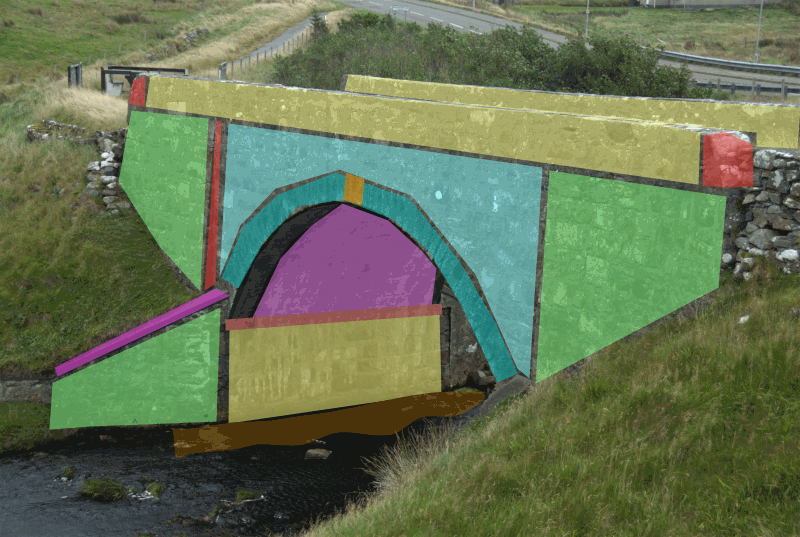
parapet endings

The parapet ends curving down through a quadrant and are strong and robust. The coping, often a rowlock course (brick-on-edge) follows the diameter of the quadrant.

parapet

It is a low wall for the safety of pedestrians and cars. The coping is often a rowlock course (brick-on-edge) rarely with flagstones.

wingwall

Sidewalls (parallel or skew to road) to support backfilling of the slope, are passing towards arch into abutments. At Parliamentary bridges with a slight battering (inward slope).

ledge

Important feature of the Parliamentary-Bridges, is arising of the transition of the slight battered wingwalls (inward slope) to the vertical spandrel and voissoirs. Therefore is the ledge upside decreasing.

spandrel

The sidewise walls over the voussoirs. The spandrel follows at base the course of the vousoirs, so has the maximum height at the abutments and the minimum height at the crown. The spandrels are vertical built.

voussoirs

Sidewise arch ring under the spandrel, often built of superfine dressed stone. The keystone (stone at the top of the arch) is sometimes well styled by the stonemason. The voussoirs are running parallel to arch rings at the underside of the arch and are bondet with them.

arch ring

Sidewise arch ring underside of the arch and is bonded with the voussoirs.

arch

The arch is the properly supporting part of the bridge. It starts at the impost and is running mostly as half-circle to the crown. Sidewise it is bounded by the arch ring.

abutment

The abutmnent is formed by the open case of the impost and the high part of the spandrel.

raking wing walls

This bridge does not only have (high) parallel wing walls, but also added little raking wing walls. They were nessesary because of the quite high abutments.

crown

This is the top (highest intended) line of the arch. Outside passes the crown into the voussoirs with the keystones.

impost

The impost are laying on the abutments / foundation und are the lower line of the arch and the passing into the abutments or at smaller bridges directly into the foundation.

foundation

Groundwork of the bridge, sometimes is the in-situ rock enough as natural foundation.

coping

Top horizontal or sloping cover of a wall as protection against weather. The erection is often as a rowlock course (brick-on-edge course) or with large-size flagstones.
extensive designed arch bridge

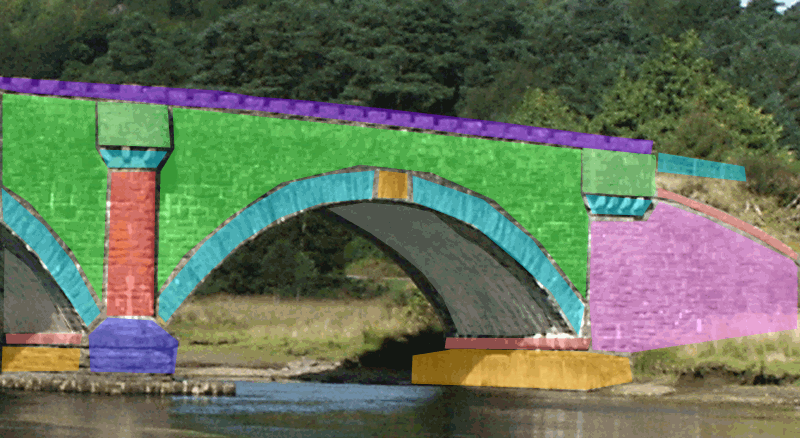
parapet

It is a low wall for the safety of pedestrians and cars. The coping is often a rowlock course (brick-on-edge) rarely with flagstones.

spandrel

The sidewise walls over the voussoirs. The spandrel follows at base the course of the vousoirs, so has the maximum height at the abutments and the minimum height at the crown. The spandrels are vertical built.

coping

Top horizontal or sloping cover of a wall as protection against weather. The erection is often as a rowlock course (brick-on-edge course) or with large-size flagstones.

wingwall

Sidewalls (parallel or skew to road) to support backfilling of the slope, are passing towards arch into abutments. At Parliamentary bridges with a slight battering (inward slope).

arch

The arch is the properly supporting part of the bridge. It starts at the impost and is running mostly as half-circle to the crown. Sidewise it is bounded by the arch ring.

crown

This is the top (highest intended) line of the arch. Outside passes the crown into the voussoirs with the keystones.

arch ring

Sidewise arch ring underside of the arch and is bonded with the voussoirs.

abutment

The abutmnent is formed by the open case of the impost and the high part of the spandrel.

impost

The impost are laying on the abutments / foundation und are the lower line of the arch and the passing into the abutments or at smaller bridges directly into the foundation.

foundation

Groundwork of the bridge, sometimes is the in-situ rock enough as natural foundation.

voussoirs

Sidewise arch ring under the spandrel, often built of superfine dressed stone. The keystone (stone at the top of the arch) is sometimes well styled by the stonemason. The voussoirs are running parallel to arch rings at the underside of the arch and are bondet with them.

railing

Among a parapet the usual anti-fall guard. Railings are later added to arch bridges, sometimes in exchange for a parapet.

cutwater

Additional footing added to a pier at water level and into the current, to divert the force of the water's flow or ice. Cutwaters are only nessesary at river piers and spating rivers. Otherwise they are also used as design element.

refuge

Alcove in the parapet for the safety of pedestrians, usually formed by a half-pillar being built above a pier or abutment. [1]

cantilever

Projecting stones are among other things used for supporting balconys and refuges and under string courses as design element.

pillar

Pillars are only linked to refuges. In combination with cantilevers are quite large refuges possible.
suspension bridge

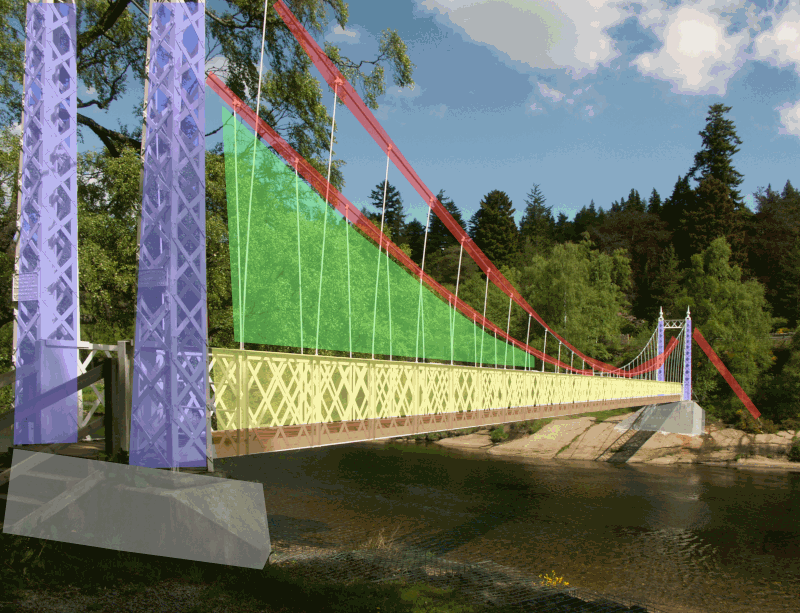
foundation

Groundwork of the bridge, sometimes is the in-situ rock enough as natural foundation.

railing

Among a parapet the usual anti-fall guard. Railings are later added to arch bridges, sometimes in exchange for a parapet.

pavement

The pavement of a suspension bridge in the Highlands is usually a plank covering. There is the pavement enought elastic for all movements of the bridge. The distance of the planks are unequal, it is also possible that a plank is cracked. To enter lonely suspension bridges is an adventure. Often is the pavement in the middle of the bridge protected by a wire to the banks against horizontal movement. Lengthwise are at both sides girders to fasten the suspenders.

pylon

The pylons are the most distinctiv parts of a suspension bridge. Their height have a stake in the forces of the cables: at high pylons results a higher catenary sag and a lower cable-force by the same span. They can designed as steel truss or as a simple tree trunk. The pylons have a connection at top for better stability. They have a great variety of shapes.

cables

The cables are starting from the fundation behind the pylons passing the top of the pylons and are going to the opposite bank. There are used steel cables, which could have a diameter of some centimeters.

suspender

The suspenders are the connection between the lengthwise girders of the pavement and the cables. The cable clips are very different. Additional is the railing (sometimes also wires) at the suspenders fastened.